Capt Anil Kumar Mehta
July 22, 2024
The degree of maritime supremacy where in the opposing force is incapable of
effective interference will change with the role of Unmanned Combat Aerial Vehicles
(UCAV) as this will become the key component in conflicts. Worldwide there would be
many UCAVs customized for maritime applications for naval forces which will add
another dimension in determining the outcome of battle amidst challenging technologies.
Presently maritime missions with UAV are ISR (Intelligence, Surveillance and
Reconnaissance) missions. Developing a stealthy long range drone with a weapon
payload that could go beyond and survive against the modern air defence is a challenge.
UCAVs would show promise in achieving these missions.
Navies of the world have decided to go for an Unmanned Carrier Launch and
Surveillance & Strike (UCLASS) system. The UCLASS is being designed to provide Navy
carriers with long range surveillance and strike capabilities to target terrorists (Anti
Piracy). UCAVs would be capable of rapid deployment from carriers which could stay out
of the range of threats. A persistent surveillance capability that could also strike vital
command & control and air defence sites if required could shift the paradigm of
strategies/patterns/theories of Maritime Warfare.
In present day scenario Unmanned Aerial Systems (UAS), are offering
comprehensive maritime solution, which complies with every country's operational needs.
There is a need to positively and unambiguously identify, in time, threats that originate in
the maritime arena and prevent hostile and illegal activities in its territorial water or
against areas within its range. Such activities may include illegal fishery, piracy, terror
activities and any other activity aimed against the country's sovereignty. These threats
can be small or large targets with various radar cross sections and thus require means
with pin-point detection and identification capabilities.
The maritime UAV systems are providing Over The Horizon Targeting (OTHT) in
security, paramilitary and wartime missions. The maritime UAVs are being employed for
real time battle damage assessment. During peace time the maritime UAV system
prevents the penetration of any sea borne hostile intruder, protects the country's rights
and interests in the Economic Exclusive Zone (EEZ) and supports in Search and Rescue
operations. In war time the maritime UAV system achieves naval superiority, assists in
destruction of enemy naval forces and defends the coast lines and support ground
operations (littoral warfare). UAV systems are capable of carrying multiple payloads and
sensors simultaneously and provide a array of intelligence gathering capabilities from
target detection to its positive identification.
UAVs with maritime capabilities enable total mission control on both from land
based or sea based. The control of UAV can be transferred from land to sea and vice
versa in real-time. With SATCOM controlled UAVs the scanning area and time over target
is increased thus enhancing its mission flexibility. UAV with SATCOM control can play the
role of a force multiplier to various vessels in any maritime theater with over the horizon
ISR and target designation. Concept of operation with maritime UAV system will be
prepared in order to support the navy missions in war and peacetime. The role of the
Maritime UAV system is to provide unmanned, long endurance, aerial reconnaissance,
surveillance and target acquisition. In addition, the UAV can create a comprehensive, real
time, naval tactical picture for the ship’s commander and naval headquarters. Aircraft
equipped with a SATCOM dish can fly to a distance limited only by the fuel quantity
carried on board and the SATCOM coverage.
VTOL UAV Systems is based upon a conversion of a commercial helicopter
platform into a VTOL UAV. The unmanned Helicopter configuration is available at low
price and can utilise existing platforms. The VTOL UAV systems will fulfill the missions of
the manned naval helicopter mainly in the Dull Dirty and Dangerous missions.
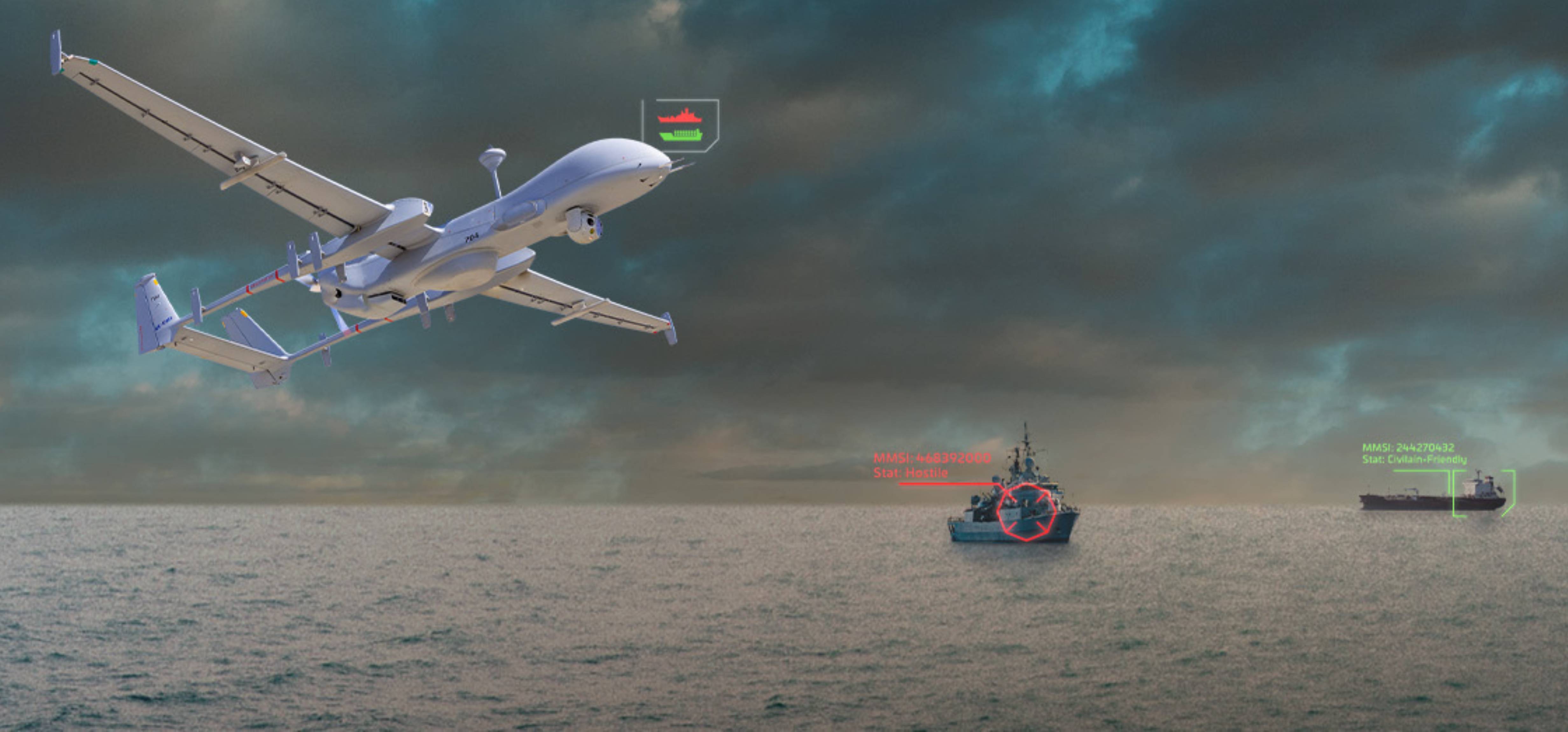
An Unmanned Combat Aerial Vehicle is a UAV that is armed and has no pilot
onboard, commonly known as “Drones”. Drones have changed the nature of modern aerial
combat. Controllers of drones are in no immediate danger unlike jet pilots. In UCAV, much
of equipment necessary for a human pilot (such as cockpit, ejection seat, flight controls
and environmental controls) can be omitted from a UAV resulting in a decrease in weight.
This allows greater payload, range and maneuverability.
UCAVs are great force multiplier. In a network centric environment where we have
less response time between situational awareness, sensing and destruction, the UCAV
will be the most important weapon. UCAVs are capable of undertaking very high risk or
typically very high attrition roles in which the use of manned aircraft is regarded to be
problematic. Current systems tend to be remotely ‘piloted’ by a ground controller, who is
then also responsible for conducting any armed engagements. However, future concepts
focus on UCAVs that can operate with higher degrees of autonomy, conducting missions
with little controller influence following the input of mission information. The weapons
employed from a UCAV are generally conventional air-to-ground guided munitions. In the
future, micro-munitions, Directed Energy Weapons and weapons for air-to-air combat
could be used from UCAVs.
The vertical take-off and landing capabilities of Camcopter UAV is very suitable
for maritime operations. Landing on helicopter deck-equipped ships without requiring
launch and recovery equipment will be future of UAV/UCAV. It could either be
programmed to fly an autonomous mission profile via a simple point-and-click graphical
user interface or controlled manually. The vehicle is capable of carrying variety of
payloads depending on the mission. These include day and night thermal cameras
(simultaneously), multi-spectral sensors, a synthetic aperture radar, a laser imaging radar
and a ground penetrating radar.
Operational finesse can only be achieved by tuning these machines and equipment
for our theater of operations. UCAV’s are the machines of future, thus there is a need to
reconfigure our doctrine and war fighting capabilities and see as to how best can these
be configured in overall process. UCAV’s should be capable of engaging air to air and air
to surface targets. Types of weapons available worldwide that give precision, surprise
and lethality are appended below:-
(a) Loitering Missiles - These missiles are capable of achieving pin point
accuracy. Loitering missiles are very effective for surgical strikes. They can be pre
programmed or controlled from the ground.
(b) Laser Guided bombs - LGB’s require high accuracy and a line of sight
between the deployment platform and the target. Greater technological challenges
will be to produce the UCAV’s which are stealthy accompanied with high speed so
that these UCAV’s can shoot and scoot from the theater of operation.
(c) Air to Air Missiles - LGB’s require high accuracy and a line of sight
between the deployment platform and the target. Greater technological challenges
will be to produce the UCAV’s which are stealthy accompanied with high speed so
that these UCAV’s can shoot and scoot from the theater of operation.
(d) Air to Surface Missiles - Conventional air to ground missiles for ISR UAV’
s will be required for providing greater precision and more localized effects. These
will be required for advanced stealthy UCAVs. Air to surface missiles will ensure
survivability. Large UCAVs will have an edge over the enemy when fitted with new
small agile expendable UCAVs.
(e) Micro Munitions - This class of weapons will be required for smaller
UCAV’s which demand for greater stealth and high speed. Micro Munitions will be
smaller and lighter than conventional missiles and can also be carried internally
improving the stealth characteristics of delivering platforms. These will have
application across all types of UCAV’s. The range of these munitions may be
limited, reducing their suitability for platforms that stand off from the targets.
UCAVs will employ a range of new and advanced weapons many of which will
depend on overcoming some significant technological challenges. There employability
will depend on the size and weight of the weapons. In line with evolving UAV technology,
manufacturers continue to design and develop more advanced UAVs with increased
payload and performance capabilities. The technology is leap forging worldwide for
arming the UAV’s.
UAV technology continues to improve in terms of platforms, flight control systems,
autonomy, and sensors. UAVs are proceeding to the next stages of research and
development and will integrate with UCAVs on the future battlefield to accomplish such
missions as target identification and handoff. UCAVs may operate as armed UAVs for
some missions or as UAV protection. Some UAV and UCAV subsystems probably will use
synchronous technologies and even interchangeable components.
Evolving concepts of operation call for simultaneous and co-ordinate operation of
multiple UAV’s, operated partly autonomously, while mutually supporting each other with
ISR and weapons coverage. Such constellations of UAV’s will provide war fighters with
rapid response when engaging time critical targets at reduced rate of response between
target detection, targeting and engagement. Thus call for a paradigm shift in Maritime
Warfare.
Written by,
July 22, 2024
Nowadays, We are seeing how much drones have improved our modern life. From on-demand parcel delivery to surveying.......
Learn MoreToday retail video analytics has gone past the conventional area of security by giving retailers smart business insights......
Learn MoreExperience in completing a project is unique. This is a documentation on constructing a boundary across an open well.....
Learn More